
















Airsoftpedia Choosing your gear
Your guide to airsoft batteries and chargers
When it comes to AEG batteries, there are three types today, each with its own pros and cons, which we go through in this article.
When it comes to the physical side of batteries, there are a few things people usually consider:
Capacity – How much energy the battery holds, measured in mAh (milliamp hours). The more capacity, the more shots you get out of the battery.
Voltage – How much power the battery delivers. The higher the voltage, the faster the trigger response and the more rounds per second the rifle fires.
Size – The physical size of the battery, as you want to maximise the amount of energy you can fit in the rifle.
Price – What a new battery costs if it breaks or needs replacing.
NiMH:
NiMH batteries are the most common battery type. If a battery comes with the gun, it is typically NiMH, as it is also the easiest to use: this battery type can be run completely flat without being damaged.
NiMH batteries are typically between 1100 and 1600 mAh, which is a very normal capacity.
The NiMH batteries used for airsoft are typically either 8.4 V or 9.6 V. While 8.4 V was the standard a few years ago, more rifles now come with 9.6 V from the factory to give better performance out of the box.
If the rifle comes with a NiMH battery, we recommend sticking with one of the same voltage, as that is typically what the gun is designed for.
The biggest drawback of NiMH batteries is their physical size relative to their capacity. As NiMH is an older technology, the batteries take up a lot of space for their capacity.
NiMH batteries are the cheapest batteries today, and with their otherwise sensible characteristics they are the most economical choice.
LiPo:
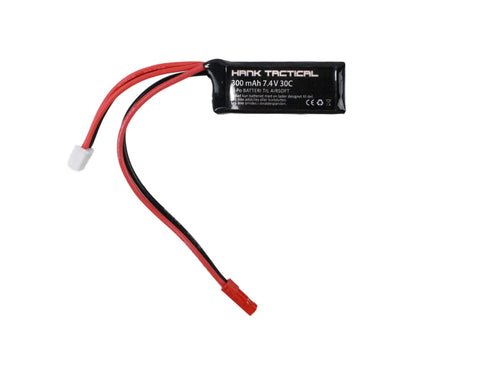
LiPo batteries are mostly used by players who have been at it for a while. They perform really well and also come in higher voltages than NiMH, so they are often used in upgraded high-performance rifles. Unlike NiMH, however, LiPo batteries cannot tolerate being run flat, so you need to take them out of the rifle when it starts to sound sluggish. If LiPos are mistreated, for example with hard knocks, they can catch fire.
LiPo batteries for AEGs are commonly available from 1000 mAh up to more than 3000 mAh, so you can almost always maximise battery capacity for the space where the battery sits in the rifle.
LiPo batteries are typically either 7.4 V or 11.1 V, and all standard rifles can be used with a 7.4 V battery. Most high-end rifles today can handle 11.1 V out of the box, which gives them a really good trigger response and a high rate of fire.
LiPo batteries have a very good size-to-capacity ratio: you can typically fit around 2000–2200 mAh where there would be room for around 1600 mAh of NiMH.
LiPo batteries sit in the middle price-wise, with larger 3300 mAh batteries at the top end. Good performance, good capacity for their size and a sensible price make LiPo the most widely used battery type.
Li-ion:
Li-ion batteries are the newest battery technology on the market and are still being developed. Li-ion batteries combine the advantages of NiMH and LiPo: they can be run flat like a NiMH battery and at the same time deliver the same current as a LiPo, so they deliver high performance all the way. They look a lot like NiMH batteries but have many more advantages.
Li-ion batteries are known for their very high capacity – usually more than twice the mAh of a NiMH battery of the same size, typically starting at 2400 mAh and up.
The batteries come as either 7.4 V or 11.1 V and therefore deliver the same performance as a LiPo battery, so on this point too they are a very sensible battery.
A Li-ion battery is about the same size as a NiMH battery but usually holds more than twice the mAh, so a single battery can easily last a full day of play.
At first, Li-ion batteries were very expensive because the technology was new, but as it has developed further, prices have come down.
All things considered, Li-ion batteries are becoming the best choice if you are looking for new batteries.
Chargers:
When choosing a charger for your batteries, there are plenty of options in just as many price ranges, depending on which extra features you want. Simple chargers usually just need to be connected to the battery and then you press "Charge" to start. They are easy to use but cannot be controlled beyond starting and stopping.
Beyond that, there are what are usually called multi-chargers, for when you want to control exactly how fast and how hard you charge, and be able to charge most battery types.
Charging NiMH:
NiMH batteries are typically the standard if one comes with the rifle.
Many rifles also come with a charger without what we call "auto-stop", which means the included charger does not stop charging the battery by itself, even when it is already fully charged. Over time this can damage the battery and potentially ruin it. We therefore always recommend buying a NiMH charger with auto-stop sooner rather than later.
Charging LiPo:
When charging a LiPo battery, it is very important to always use a charger that can specifically charge LiPo batteries. If you try to charge them with another type – people are occasionally seen using a NiMH charger – you risk the battery swelling up and, in the worst case, catching fire or exploding. We therefore also recommend getting a fire-safe LiPo safety bag to keep them in while charging. Even though this makes LiPo batteries sound dangerous, you can use them safely as long as you treat them with a certain respect.
If you are interested in seeing the range and perhaps buying a new battery or charger, we have a whole category just for that – click here to find it