















You have zeroed your air rifle, settled into a comfortable position – and the pellet still does not land where the reticle was. One of the most overlooked causes is parallax. At the short distances you typically shoot at with an air rifle, parallax matters more than at centrefire hunting distances, so it is worth understanding what it is and how to set it correctly. In this guide we cover what parallax is, the difference between AO and side focus, and how to set up your riflescope step by step.
What is parallax?
Inside a riflescope, the objective lens forms an image of the target, and the eyepiece magnifies that image together with the reticle. Parallax occurs when the target image and the reticle do not lie in the same plane inside the scope. The reticle then appears to move relative to the target when you move your head slightly behind the scope – even though the rifle is perfectly still.
In other words: if your eye is not exactly centred behind the eyepiece, you are aiming somewhere other than you think. The further the target is from the distance the scope is set to, and the further your eye is off-centre, the larger the error.
Parallax is closely linked to sharpness. When the parallax is set to the correct distance, the target is sharp and the reticle stays put on the target, wherever your eye is. When it is set incorrectly, the image is more or less blurred and the reticle "swims".
Why is parallax especially important on air rifles?
Many riflescopes leave the factory with parallax fixed at around 100 metres (or 100 yards, approx. 91 m), and some scopes for rimfire rifles at 50 metres. That suits hunting with a rifle, but most air rifle shooters shoot at 10–50 metres. When there is a big gap between the fixed setting and the distance you actually shoot at, you get both a less sharp image and a risk of the reticle moving if your head is not in exactly the same position every time.
- Short distances: At 10–25 metres you are furthest from a fixed 100 m setting. This is where adjustable parallax makes the biggest difference.
- High magnification: The more you zoom in, the more obvious the parallax error becomes. At low magnification (2–4x) it is rarely a problem in practice.
- Small targets: In target shooting, field target and pest control you have to hit small areas, and here an error of a few millimetres matters.
AO or side focus – what is the difference?
Riflescopes with adjustable parallax come in two versions. Both do the same thing – they move the image plane to match the distance – but they are operated differently.
AO (Adjustable Objective)
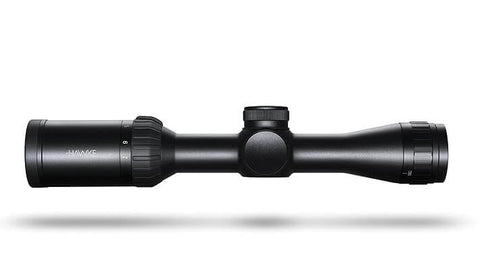
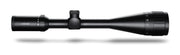
Here you turn a ring out at the objective lens. It is the classic solution and is found on many affordable scopes, such as the Hawke Vantage 2-7x32 AO, which can be set from 5 metres to infinity, and the Hawke Vantage 4-12x40 AO from 9 metres. The downside is that you have to lift your head off the stock and reach forward to the objective to adjust it.
Side focus (SF)
Here the parallax adjustment sits as a turret on the left-hand side of the scope. You can adjust it without breaking your shooting position, and many side focus scopes can be fitted with a larger side wheel. A side wheel makes fine adjustment easier and gives you room to mark distances on it. The FX 6-18x44 SFIR is an example of a side focus scope that comes with a side wheel.
How to set the parallax – step by step
- Focus the eyepiece first. Point the scope at a bright, plain surface (such as the sky) and turn the eyepiece dioptre until the reticle is sharp straight away. You only need to do this once, and it is the basis for the parallax adjustment working correctly.
- Rest the rifle steadily. Use a shooting rest or sandbag so the rifle does not move during the test.
- Choose high magnification. Parallax error is easiest to see at high zoom.
- Turn the AO ring or side focus until the target is as sharp as possible.
- Do the head test. Slowly move your head slightly up, down and to the sides behind the eyepiece. If the reticle stays put on the target, the parallax is set correctly. If it moves, adjust a little more and repeat.
- Note the distance. If you often shoot at the same distances, you can mark them on the side wheel or write them down. That makes it quick next time.
The numbers on the AO ring or side focus are a guide. Use them as a starting point, but trust the head test and a sharp image.
Parallax as a rangefinder
In field target shooting, many shooters use the parallax adjustment to judge the distance to the target: when the image is sharp at high magnification, the distance can be read off a side wheel marked with distances. This requires you to have calibrated the wheel yourself at known distances, but it is an effective method, because a pellet's trajectory from an air rifle is curved, and you need to know how much to hold over or under.
Read more about holding over and under with a Mil Dot reticle in our article Hawke – know your scope for long-range shooting.
Do you have a scope with fixed parallax?
That does not mean you need to replace it. Many shooters do well with a fixed-parallax scope, especially at low magnification. The most important thing is to place your cheek in the same spot on the stock every time, so your eye is centred behind the eyepiece. That keeps the parallax error to a minimum, even if the scope is set for a longer distance.
- Turn the magnification down at short distances.
- Work on a fixed, consistent cheek weld – an adjustable cheek piece can help.
- Use the head test to check how much the reticle moves at your typical distances.
Remember the right scope for spring air rifles
Spring air rifles have a recoil that goes both forwards and backwards, and that puts more strain on optics than firearms do. So choose a scope that the manufacturer states is rated for spring air rifles, and tighten the scope rings evenly and with moderate force so the tube is not deformed. Browse our full range of optics for air guns, and read our guide to choosing the right riflescope or red dot sight.
Our recommendations
- Hawke Vantage 2-7x32 AO, Mil Dot: A compact scope where the parallax can be set all the way down to 5 metres. A good choice for air rifles used mainly at short distances in the garden or at the range.
- Hawke Vantage 4-12x40 AO, Mil Dot: More magnification for target shooting and pest control, with parallax from 9 metres to infinity.
- FX 6-18x44 SFIR: Side focus with a side wheel included and an illuminated reticle. For shooters who shoot at longer distances and want to adjust the parallax without breaking their shooting position.
Not sure which scope suits your air rifle? Get in touch, or visit our shop and workshop in Aulum, Denmark – we are happy to help.